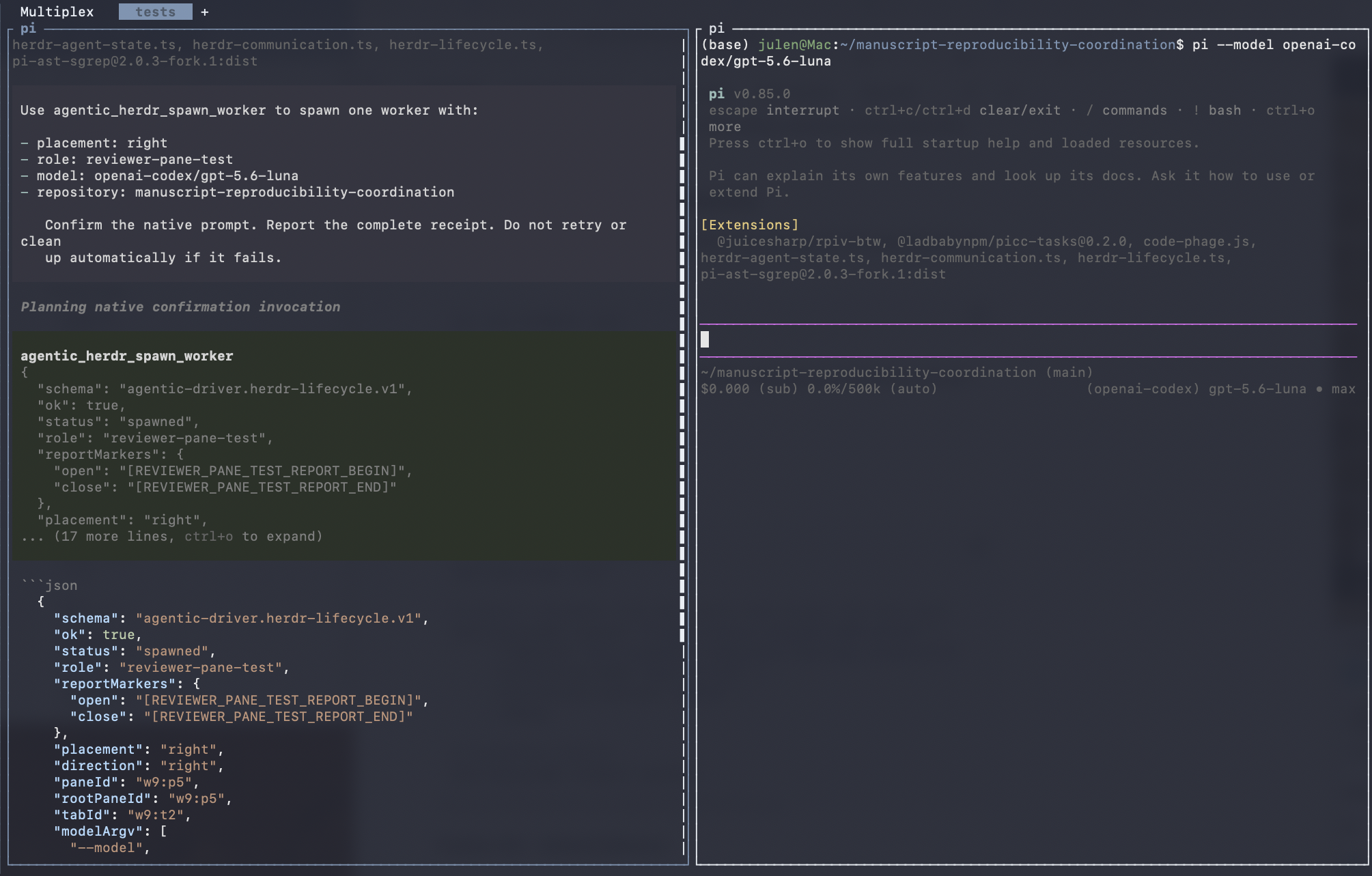
Dispatching a Multi-Model Workforce from Anywhere
How the Agentic Driver extension set uses Herdr and Pi to route tasks by role, model and machine—and keep persistent sessions within reach from a laptop, phone or remote terminal.

Agent systems · models · evaluation
Writing and evidence: agent systems, models, evaluation and computational biology.
How the Agentic Driver extension set uses Herdr and Pi to route tasks by role, model and machine—and keep persistent sessions within reach from a laptop, phone or remote terminal.
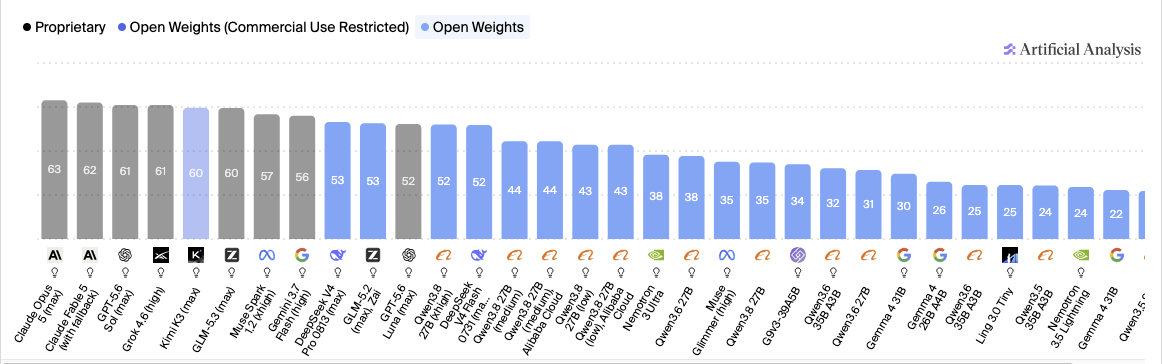
How I manage Qwen's tendency to go off on a long reasoning run, why completion limits are not enough, and where quantisation creates a second serving problem.

Why AI infrastructure keeps rediscovering established primitives, and how to distinguish useful standardisation from inflated novelty claims.
Model state, session history and external retrieval belong to different parts of the agent system.
From finishing my PhD to keeping knowledge, model choice and authority in my own systems.
Four serving recipes for GLM-5.3-Flash on two DGX Sparks. The recipe that answers fastest is not the one that generates fastest, and none of the four escapes the constraints that matter for real agent work.
How I manage Qwen's tendency to go off on a long reasoning run, why completion limits are not enough, and where quantisation creates a second serving problem.
The project brief: a task-bound Implementer, what it learned, and what the coding tests showed.
Two starting checkpoints, executable training evidence, and fifteen paired coding-retention runs.
Seven local models, 184 output-prediction problems, and a prompt change that helped some and hurt others.
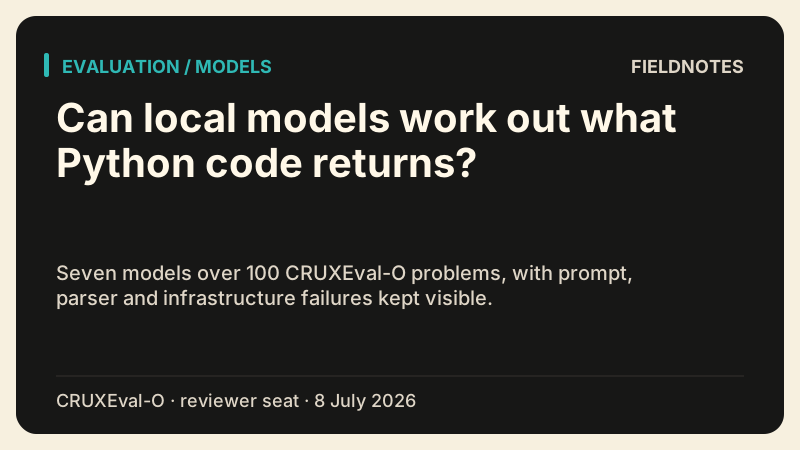
Seven models over 100 CRUXEval-O problems, with prompt, parser and infrastructure failures kept visible.

Is published research data ready to train models? I revisit four circadian ChIP-seq studies and what their raw data can support under consistent reanalysis.
Four serving recipes for GLM-5.3-Flash on two DGX Sparks. The recipe that answers fastest is not the one that generates fastest, and none of the four escapes the constraints that matter for real agent work.
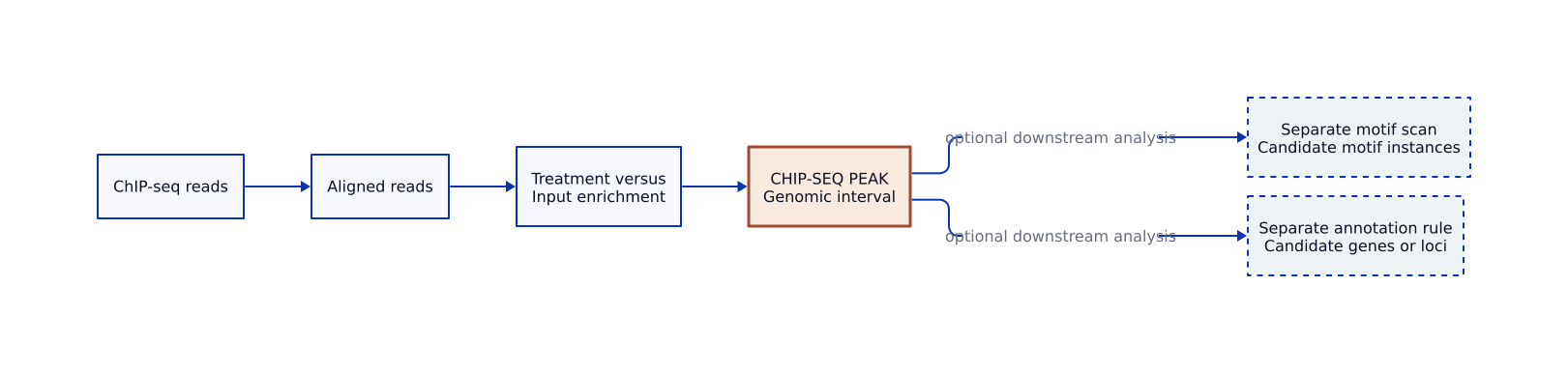
A method reconstruction, sensitivity analysis and local ENCODE-equivalent comparison for public mouse liver circadian factor ChIP-seq. No tested condition reproduced both the deposited peak counts and the peak sets.
Choosing a model for a specific job, and deciding what to change when it fails.
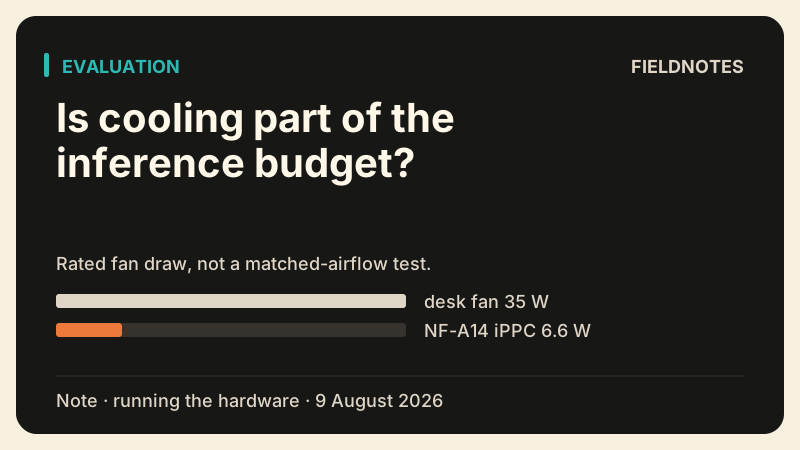
A 6.6 W fan, a 35 W desk fan, and the cost of keeping a model running.
Two starting checkpoints, executable training evidence, and fifteen paired coding-retention runs.
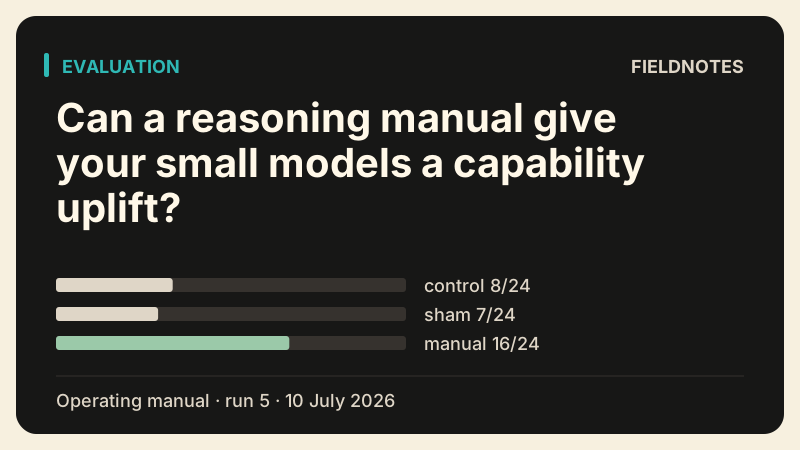
Run 5: a small-model signal on a storage-budget trap, with a same-length sham control.
Seven local models, 184 output-prediction problems, and a prompt change that helped some and hurt others.
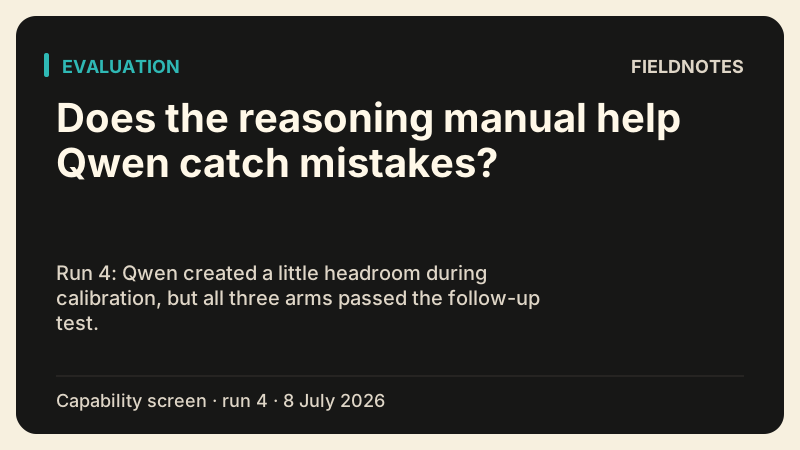
Run 4: Qwen created a little headroom during calibration, but all three arms passed the follow-up test.
Seven models over 100 CRUXEval-O problems, with prompt, parser and infrastructure failures kept visible.
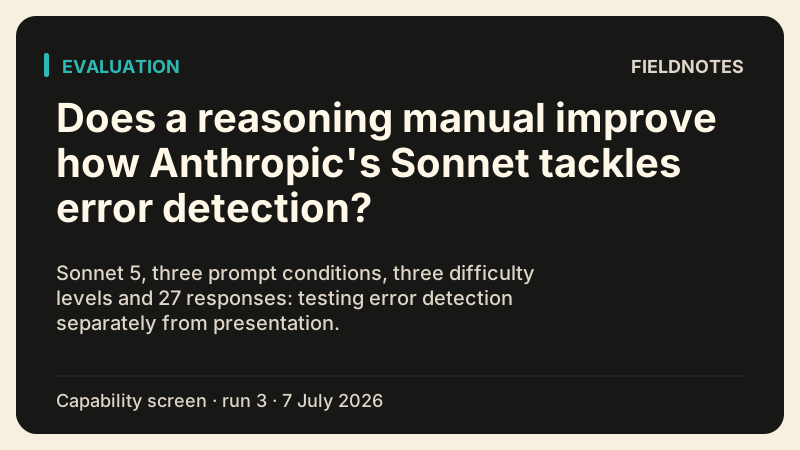
Sonnet 5, three prompt conditions, three difficulty levels and 27 responses: testing error detection separately from presentation.
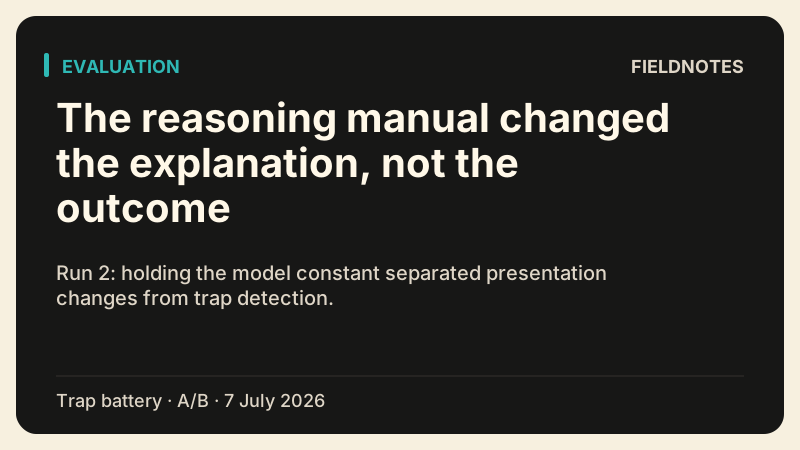
Run 2: holding the model constant separated presentation changes from trap detection.
Is published research data ready to train models? I revisit four circadian ChIP-seq studies and what their raw data can support under consistent reanalysis.
A method reconstruction, sensitivity analysis and local ENCODE-equivalent comparison for public mouse liver circadian factor ChIP-seq. No tested condition reproduced both the deposited peak counts and the peak sets.
Is published research data ready to train models? I revisit four circadian ChIP-seq studies and what their raw data can support under consistent reanalysis.
Four serving recipes for GLM-5.3-Flash on two DGX Sparks. The recipe that answers fastest is not the one that generates fastest, and none of the four escapes the constraints that matter for real agent work.
How the Agentic Driver extension set uses Herdr and Pi to route tasks by role, model and machine—and keep persistent sessions within reach from a laptop, phone or remote terminal.
How I manage Qwen's tendency to go off on a long reasoning run, why completion limits are not enough, and where quantisation creates a second serving problem.
Why AI infrastructure keeps rediscovering established primitives, and how to distinguish useful standardisation from inflated novelty claims.
A method reconstruction, sensitivity analysis and local ENCODE-equivalent comparison for public mouse liver circadian factor ChIP-seq. No tested condition reproduced both the deposited peak counts and the peak sets.
Choosing a model for a specific job, and deciding what to change when it fails.
Model state, session history and external retrieval belong to different parts of the agent system.
A 6.6 W fan, a 35 W desk fan, and the cost of keeping a model running.
From finishing my PhD to keeping knowledge, model choice and authority in my own systems.
The project brief: a task-bound Implementer, what it learned, and what the coding tests showed.
Two starting checkpoints, executable training evidence, and fifteen paired coding-retention runs.
Run 5: a small-model signal on a storage-budget trap, with a same-length sham control.
Seven local models, 184 output-prediction problems, and a prompt change that helped some and hurt others.
Run 4: Qwen created a little headroom during calibration, but all three arms passed the follow-up test.
Seven models over 100 CRUXEval-O problems, with prompt, parser and infrastructure failures kept visible.
Sonnet 5, three prompt conditions, three difficulty levels and 27 responses: testing error detection separately from presentation.
Run 2: holding the model constant separated presentation changes from trap detection.